Nearshoring analysis
Follow which products move to Mexican suppliers: compare US imports from Mexico and from Asia by HS code in Census statistics, then see the companies behind the trade in bills of lading and Mexico declarations.

North America coverage
CargoFax provides North America trade data for the United States and Mexico in one platform, so you can follow both sides of the same trade lane. Mexico and the United States are each other's largest trading partners: in 2026, Mexico was the top source of US imports, at US$52.4B a month in US Census Bureau statistics. CargoFax combines daily US import bills of lading, official US Census trade statistics, and Mexico customs declarations by sea and air, with declared values and RFC tax IDs. Search both markets together in Atlas, or receive the data in bulk through Files.
Last updated:
Datasets
Top US imports from Mexico
Snapshot
Both sides of the border at a glance: what the United States and Mexico traded with each other each month this year, from US Census statistics and Mexico customs declarations.
US imports from Mexico, 2026
Mexico was the top source of US imports.
US exports to Mexico, 2026
Mexico was the top destination of US exports.
Mexico imports from the United States, sea and air, 2026
Mexico exports to the United States, sea and air, 2026
The United States was the top destination of Mexico's sea and air exports. Averaged over the months with a complete export file.
2026, share of value. Source: US Census Bureau international trade statistics.
2026, share of value. Source: US Census Bureau international trade statistics.
US figures: US Census Bureau international trade statistics, general imports at customs value and total exports at f.a.s. value, every transport mode. Mexico figures: Mexico customs declarations (pedimentos) by sea and air, at declared value; land crossings by truck and rail are counted in the Census figures. All figures are monthly averages over the 2026 months published so far.
Two sides of one lane
Mexico and the United States trade more with each other than with any other partner, under the USMCA (T-MEC in Mexico), and nearshoring keeps adding suppliers, plants, and routes on both sides of the border. Each country's records describe the same trade from a different angle, and CargoFax keeps all three sources in one platform.
Each ocean shipment into the United States, with the importer, the supplier, the carrier, the vessel, the containers, the ports, and the gross weight, updated daily.
Each Mexico customs declaration line by sea or air, with the declared value in US dollars, the RFC tax ID of the Mexican company, the foreign party, the customs office, and the Incoterm.
Official US import and export values by product, partner country, US port, and transport mode, including the trucks and trains that cross the land border.
US bills of lading cover ocean shipments, Mexico declarations in CargoFax cover sea and air, and US Census statistics cover every mode, so together they show a trade lane from the single shipment up to the national total.
In practice
Follow which products move to Mexican suppliers: compare US imports from Mexico and from Asia by HS code in Census statistics, then see the companies behind the trade in bills of lading and Mexico declarations.
See which inputs Mexican manufacturers import by sea and air, from which origins and through which customs offices, next to the finished goods the United States imports from Mexico.
Follow a competitor's US imports in bills of lading and its Mexican operations in customs declarations, identified by RFC, with Vault email updates when new records match.
Competitor trackingFind US importers that already buy from Mexico, and Mexican companies that import from US suppliers, with their products, volumes, and declared values.
Buyer discoveryThe data
CargoFax holds more than 250 million US records and more than 60 million Mexico records, all datasets combined, searchable together in Atlas.
US import bills of lading from US Customs and Border Protection manifests, updated daily with about a one-day lag since January 2022; US export bills of lading, monthly since January 2020; and US Census Bureau statistics with official import and export values, monthly since January 2024.
Mexico customs declarations (pedimentos) for imports and exports, by sea and by air, at the line-item level, with the declared value in US dollars and the gross weight, updated monthly since January 2023.
In Atlas, Explorer searches US bills of lading, US Census statistics, and Mexico customs declarations in one place, Vault keeps the companies, products, and routes you follow on both sides of the border, and Vault emails you when the daily US release or the monthly Mexico release adds matching records.
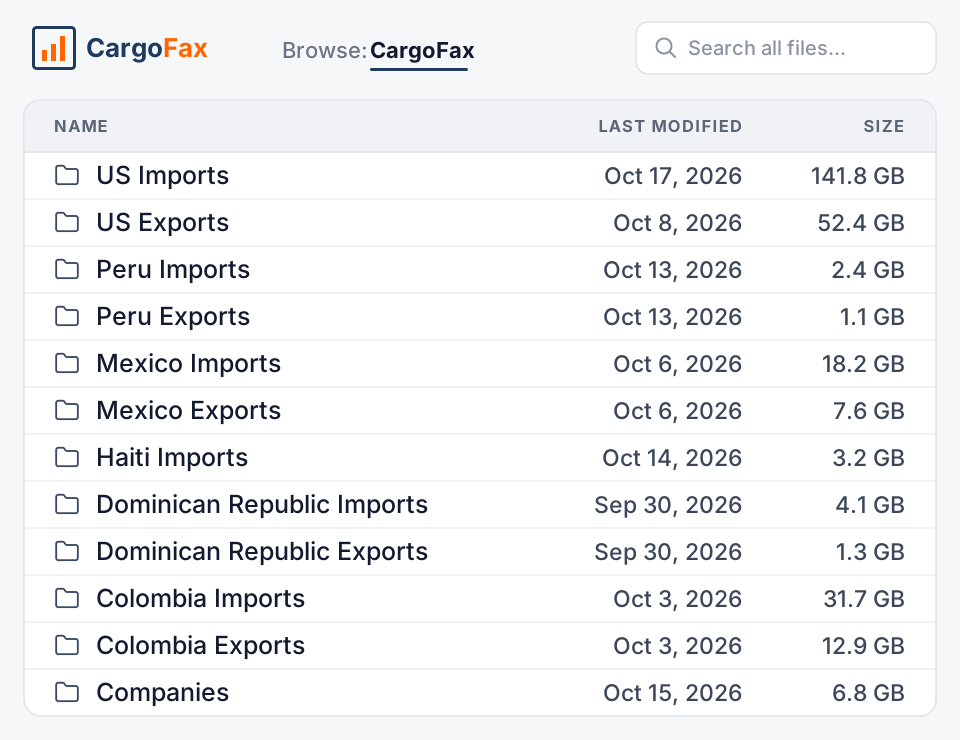
For teams that load data into their own systems, Files delivers the US and Mexico historical archives, with daily US import and monthly US export and Mexico increments, by FTP or API in CSV, Excel, JSON, or Parquet.
Reports and analysis
Three ways to stay on top of North America trade with CargoFax: the numbers, the stories behind them, and an AI analyst that digs into the records for you.
Free monthly reports with the numbers behind North American trade: US bill of lading reports (shipments, weight, carriers), US Census trade reports (official import and export values), and Mexico reports (declared values by product and partner).
A more editorial look at US and Mexico trade: the activity, developments, and findings we find interesting, with the notable trends behind them.
Claudio is our AI agent. It helps generate trade intelligence reports and explore specific commodities, companies, and trends in US and Mexico trade.
FAQ
CargoFax provides US import and export bills of lading, US Census Bureau trade statistics, and Mexico customs declarations in one platform, Atlas, with bulk delivery of both markets through Files.
Mexico and the United States are each other's largest trading partners under the USMCA. US bills of lading show the shipment, carrier, vessel, and parties, Mexico customs declarations show the declared value, the RFC tax ID, and the customs office, and US Census statistics give the official totals, so together they show both sides of the same trade lane.
Yes, in the official totals. US Census statistics in CargoFax cover every transport mode, including land crossings, by product, partner country, US port, and month. US bills of lading in CargoFax cover ocean shipments, and Mexico customs declarations cover sea and air.
US import bills of lading are updated daily, with about a one-day lag. US export bills of lading, US Census statistics, and Mexico customs declarations are updated monthly.
In CargoFax, US import bills of lading start in January 2022, US export bills of lading in January 2020, US Census statistics in January 2024, and Mexico customs declarations in January 2023.
Yes. US bills of lading name the importer and the supplier on most rows, and Mexico customs declarations carry the Mexican company with its RFC tax ID and the foreign party with its tax ID where declared. US Census statistics carry no company names.
US trade values come from official US Census Bureau statistics by product, partner country, and US port. Mexico values are the declared values in US dollars on each customs declaration. US bills of lading are reported in gross weight and shipments.
Atlas plans are monthly or annual and tailored to the markets and data access you need. See the plans page or book a demo for a quote covering both markets.
Get started
Find the suppliers, buyers, and shipping companies you need to grow your business. CargoFax trade data helps you identify real companies, discover new opportunities, and make your next move with confidence.