Solutions: traders
Trade data for commodity traders
CargoFax gives commodity traders shipment-level customs records to follow physical flows of grains, fuels, metals, fertilizers, and other goods. Traders see who ships and who buys each commodity, by origin, port, and month, and compute prices per kilogram from declared values and weights in the Dominican Republic, Mexico, Colombia, Uruguay, and Peru. CargoFax US import records are updated daily with about a one-day lag, and US trade values come from official US Census statistics. Vault emails traders when a followed counterparty ships again.
Last updated:
Questions
What can commodity traders answer with trade data?
- Where is a commodity flowing, and how much? Volumes by origin, destination, port, and month.
- What price is the market paying? Declared value per kilogram by origin and month.
- Who are the counterparties? The importers and exporters handling a commodity, by name.
- Which origins are gaining share? Month, quarter, and year comparisons by origin.
- When does a counterparty ship again? A Vault email update on each new record for a followed company or HS code.
Fields
Which records and fields matter to commodity traders?
| Field | Why it matters to commodity traders | Markets |
|---|---|---|
| HS code and description | Identifying the commodity | Every market |
| Weight | Tonnage | United States, Haiti, Mexico, Colombia, Peru, Dominican Republic, Uruguay (in tonnes) |
| Declared value | Price per kilogram | Dominican Republic, Mexico, Colombia, Uruguay, Peru; Argentina (FOB, with quantities) |
| Origin, destination, and ports | Flows and arbitrage | Every market (countries); ports on US, Haiti, and Peru records |
| Importer, exporter, tax ID | Counterparties | Names in every market; tax IDs in Mexico, Colombia, Peru, Dominican Republic |
| Vessel and carrier | Which ships carry the cargo | United States, Haiti |
Products
Which CargoFax product fits commodity traders?
Atlas
Explorer pivots any commodity by origin, company, and month. Vault keeps saved pivot tables that update as data lands, and emails you about new shipments.
See AtlasFiles
For price and flow models: the archive and each update by FTP, through a web interface, or by API, in CSV, Excel, JSON, or Parquet.
See FilesMCP
The CargoFax MCP server lets AI assistants and agents query the same shipment records. It is in early access for selected clients and prospects: fill out the request form and we will get back to you.
Request MCP accessCoverage
Which markets can commodity traders cover?
Price work starts in the markets with declared values: Colombia since January 2001 and Uruguay since January 2016 (Uruguay customs exports, excluding free zones). Argentina adds declared FOB values and quantities on every import line. US fuel flows are followed as mineral fuels (HS 27) by weight, with official values from US Census statistics.
North America
Caribbean
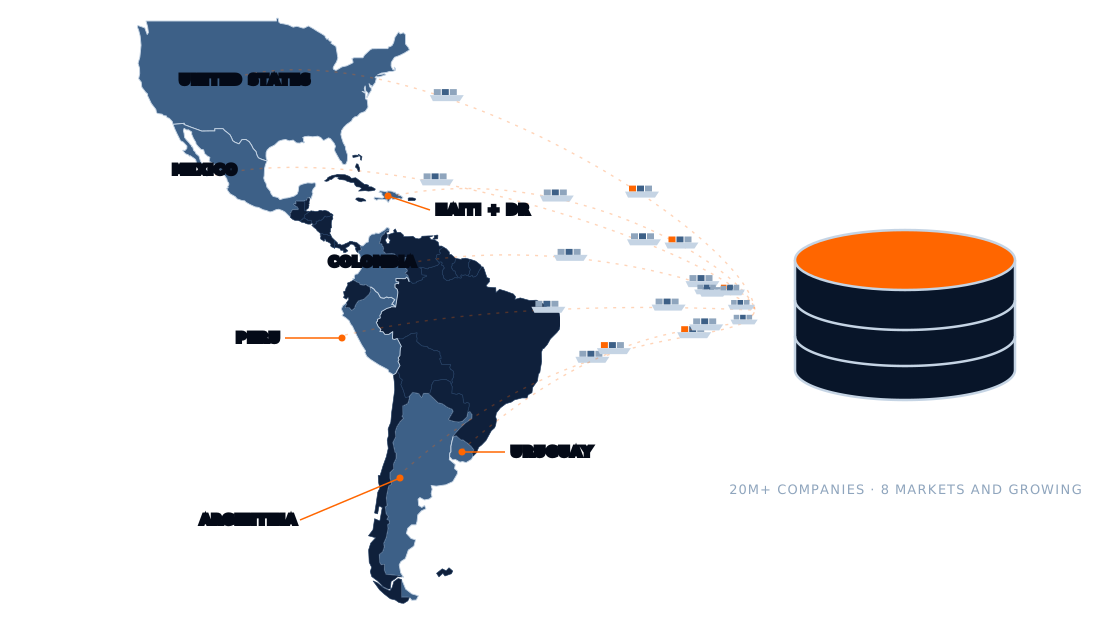
| Market | Region | Flows | History from | Values | Updates |
|---|---|---|---|---|---|
| United States | North America | Imports and exports | Imports January 2022; exports January 2020 | Official values from US Census statistics, by product, partner, and port | Daily |
| Mexico | North America | Imports and exports | January 2023 | Declared customs value | Monthly |
| Haiti | Caribbean | Imports | November 2020 | – | Weekly |
| Dominican Republic | Caribbean | Imports and exports | January 2024 | Declared USD value per line item | Monthly |
| Colombia | Latin America | Imports and exports | January 2001 | Declared customs value | Monthly |
| Peru | Latin America | Imports and exports | January 2026 | Declared customs value | Weekly |
| Argentina | Latin America | Imports | 2017 | Declared FOB value (USD) | Monthly |
| Uruguay | Latin America | Imports and exports | January 2016 | Declared CIF value (USD) | Monthly |
Use cases
Which use cases fit commodity traders?
Pricing intelligence
Compute value per kilogram by origin and month.
Pricing intelligenceMarket alerts
Hear when a counterparty or route has a new shipment.
Market alertsCompetitor tracking
Follow other traders' origins and volumes.
Competitor trackingBuyer discovery
Find the importers of a commodity in each market.
Buyer discoveryIndustries
Which industries do commodity traders search?
FAQ
Traders: frequently asked questions
Can traders compute commodity prices from customs data?
Yes, in the markets whose customs records carry declared values and weights: the Dominican Republic, Mexico, Colombia, Uruguay, and Peru. Divide declared value by weight in CargoFax Atlas Explorer to get price per kilogram by origin and month. Argentina import lines carry declared FOB values and quantities for unit prices.
Which commodities can I follow in CargoFax?
Any product with an HS code, such as cereals (HS 10), mineral fuels (HS 27), fertilizers (HS 31), iron and steel (HS 72), and copper (HS 74). Every CargoFax market carries HS codes.
Can I see who trades a commodity?
Yes. Every CargoFax market names the local importer or exporter. US and Haiti records also name the shipper, and Mexico, Colombia, and the Dominican Republic name the foreign party.
How should I analyze US crude oil and fuel imports?
Follow them as mineral fuels (HS 27) as a whole, by weight, on CargoFax US bill of lading records, where HS codes are assigned from the cargo description. Official US values by HS code come from US Census statistics.
Where do US trade values come from?
From official US Census statistics by product, partner, and port, which CargoFax publishes in its US Census trade reports. CargoFax US bill of lading records add shipments, companies, carriers, containers, and weight.
How current is commodity data in CargoFax?
CargoFax US import records are updated daily with about a one-day lag. Haiti and Peru records are updated weekly. US exports, Mexico, Colombia, the Dominican Republic, Uruguay, and Argentina are updated monthly.
Can I feed CargoFax data into my models?
Yes, through CargoFax Files, by FTP, through a web interface, or by API. CargoFax Files delivers the United States, Mexico, Colombia, Peru, the Dominican Republic, Uruguay, and Argentina in bulk, and Haiti bulk files are available on request from sales.
How much does CargoFax cost for traders?
CargoFax plans are monthly or annual and priced by markets and data access. Book a demo for a quote.
Get started
Trade on evidence with CargoFax trade data.
Find the suppliers, buyers, and shipping companies you need to grow your business. CargoFax trade data helps you identify real companies, discover new opportunities, and make your next move with confidence.