Mexico coverage

Mexico Trade Data

CargoFax provides Mexico customs data for imports and exports, by sea and by air. Mexico records are pedimentos (Mexican customs declarations), not bills of lading. Each record is one pedimento line item with the declared value in US dollars, the gross weight, and the RFC tax ID of the Mexican company. Mexico records are updated monthly and start in January 2023. CargoFax holds more than 60 million Mexico records across four datasets. Search them in Atlas next to US bills of lading and the rest of Latin America, or receive the full dataset in bulk through Files.

Customs declarations for both directions of Mexico's trade, with values and weights.

Last updated:

Mexico

Datasets

  • Imports and exports, sea and air (4 datasets)since January 2023, monthly

Top imports by HS chapter

HS 85 Electrical equipmentHS 84 Machinery and computersHS 87 Vehicles and parts
Population, 2026
134.4 million
GDP, 2026 (current US$)
US$2.2 trillion
Average monthly imports, 2026
US$30.7B
Records in CargoFax
More than 60 million

Snapshot

What does Mexico trade look like in 2026?

Mexico at a glance: the country's size, and what its trade averaged each month this year in the records CargoFax publishes.

Average monthly imports, 2026

Customs value
US$30.7B
Weight
63.8M t
Declaration lines
1.72M

Sea and air declarations only, as in the CargoFax Mexico monthly reports. Weight is averaged over the months whose import records carry complete weights.

Average monthly exports, 2026

Declared value
US$13.4B
Weight
17.5M t
Declaration lines
466K

Sea and air declarations only. Months with an incomplete export file are left out of the average.

Top imports by HS chapter
Electrical equipment (HS 85)23.2%
Machinery and computers (HS 84)22.5%
Vehicles and parts (HS 87)8.2%
Mineral fuels and oils (HS 27)7.0%
Aircraft (HS 88)2.7%

2026, share of value. Source: Mexico customs import declarations (pedimentos), sea and air.

Top exports by HS chapter
Vehicles and parts (HS 87)19.8%
Machinery and computers (HS 84)13.2%
Ores (HS 26)13.0%
Mineral fuels and oils (HS 27)12.1%
Electrical equipment (HS 85)7.7%

2026, share of value. Source: Mexico customs export declarations (pedimentos), sea and air.

Population and GDP: IMF World Economic Outlook, October 2026, 2026 estimates. Trade figures: CargoFax monthly report data, averaged over the months of the year published so far.

The data

What does CargoFax Mexico data cover?

CargoFax holds more than 60 million Mexico records, all datasets combined.

Mexico datasets in CargoFax: date range, update frequency, and number of variables
DatasetDate rangeUpdatesVariables
Imports and exports, sea and air (4 datasets)January 2023 to August 2026Monthly30 in each file

For research teams and platforms: Mexico data is also delivered in bulk through Files (FTP or API) and licensed to universities for academic research.

01

Imports and exports, sea and air (4 datasets)

One record per pedimento line item: imports by sea, imports by air, exports by sea, and exports by air, with the same fields in each. Both parties are named, with tax IDs on both sides, and each line carries the declared value in US dollars, gross weight, quantities, Incoterm, and customs regime.

Key fields

  • Declaration date
  • Pedimento number
  • HS code (10-digit TIGIE)
  • Product description
  • Customs office
  • Customs state
  • Origin or destination country
  • Mexican company
  • RFC tax ID
  • Foreign party
  • Foreign party tax ID
  • Foreign party country
  • Transport mode
  • Gross weight (kg)
  • Quantity, tariff unit
  • Quantity, commercial unit
  • Value (US$)
  • Exchange rate
  • Incoterm
  • Customs regime
  • +5 more variables

Why pair Mexico data with US data?

Mexico sits at the center of nearshoring and China+1 sourcing decisions for North American supply chains. In 2023, Mexico passed China as the largest source of US goods imports, according to US Census Bureau trade data. The CargoFax Mexico monthly reports follow Mexico's imports by origin country each month. With Mexico customs declarations and US bills of lading in the same platform, you can follow a product category from its suppliers into Mexico and, for goods that continue north by sea, into the United States. Researchers use the same pairing to study how importers re-source after a tariff change, product by product.

Mexico records carry the declared value of each declaration, so you can size a market in dollars, compare unit values across origin countries, and see which suppliers win business on price. Incoterms appear on nearly every row.

How does Mexico data reach you?

In Atlas, Explorer searches every Mexico declaration, Vault keeps the products and partner countries you follow, and Vault emails you when the monthly release adds matching records.

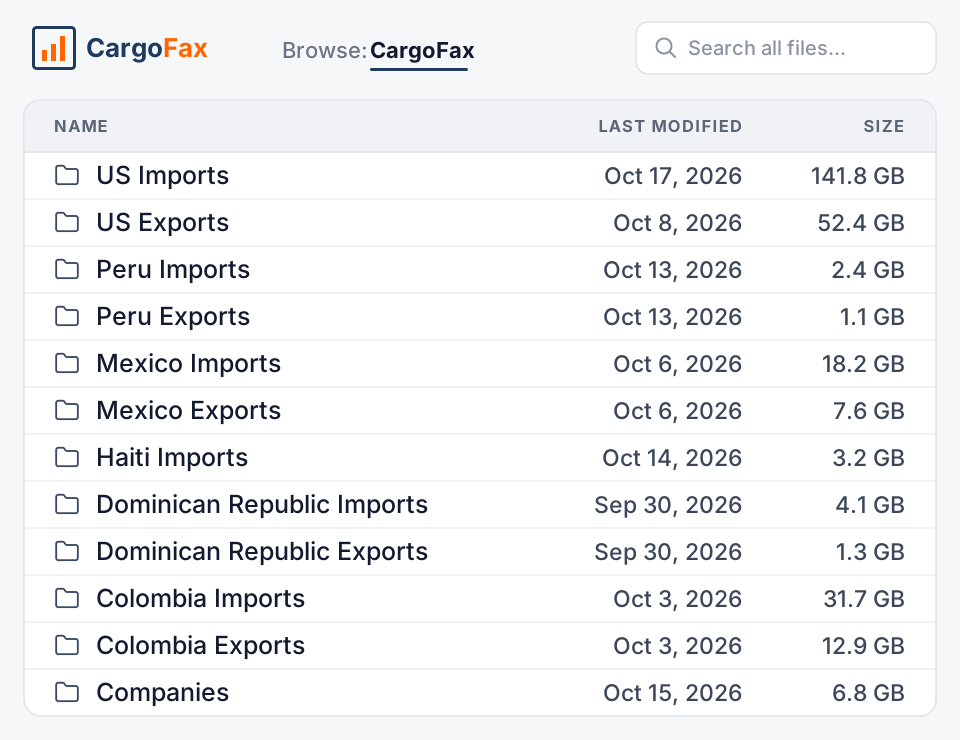
For teams that load data into their own systems, Files delivers the historical archive and monthly increments by FTP or API in CSV, Excel, JSON, or Parquet.

CargoFax Files: folders of bulk datasets by market, with the date each was updated and its size

Reports and analysis

Where can I follow Mexico trade every month?

Three ways to stay on top of Mexico trade with CargoFax: the numbers, the stories behind them, and an AI analyst that digs into the records for you.

CargoFax newsletter: Below Deck

A more editorial look at Mexico trade: the activity, developments, and findings we find interesting, with the notable trends and insights behind them.

FAQ

Mexico trade data: frequently asked questions

Where can I get Mexico import data?

CargoFax provides Mexico customs declarations for imports and exports, with declared values and weights, in Atlas and through Files for bulk delivery.

Is Mexico import data based on bills of lading?

No. Mexico import and export records in CargoFax are pedimentos, the customs declarations of Mexico, not bills of lading. Each pedimento line item carries the declaration date, the pedimento number, the 10-digit tariff code, the product description, the customs office, the Mexican company and its RFC tax ID, the foreign party, the transport mode, the gross weight, quantities, the declared value in US dollars, and the Incoterm.

Is Mexico customs data public?

Aggregate Mexico trade statistics are public. Searching individual customs declarations by product, partner country, and month, with value and weight on each record, requires a dataset like the one CargoFax maintains.

How often is Mexico trade data updated?

Mexico records in CargoFax are updated monthly.

How far back does Mexico data go?

Mexico records in CargoFax start in January 2023, for all four datasets. Earlier history can be discussed case by case for research licenses.

What HS codes are available for Mexico?

Every Mexico record carries its 10-digit Mexican tariff code, whose first six digits are the international HS subheading, so any product can be searched by chapter, heading, or subheading.

Does Mexico data include company tax IDs?

Yes. The Mexican party carries its RFC, the most reliable key for matching companies, and the foreign party carries its tax or VAT number where declared.

Does Mexico data include exports?

Yes. The Mexico dataset covers imports and exports, by sea and by air, with the partner country on every record.

Can I compare Mexico and US imports of the same product?

Yes. Mexico declarations and US bills of lading sit in the same Atlas platform and both carry HS codes, so one product can be followed in both markets.

How much does Mexico data cost?

Atlas plans are monthly or annual and priced by markets and data access. See the pricing page or book a demo for a quote.

Get started

Unlock the Power of Mexico Trade Data

Book a demo and we'll explore the Mexico records together, to see if they can help your next growth campaign.