
Solutions: erps and crms
Trade data for ERP and CRM platforms
CargoFax supplies customs trade records that ERP and CRM platforms integrate into their existing products and workflows, so every company record shows real import and export activity. CargoFax customers in Asia already integrate CargoFax trade data into their CRM platforms to deliver more value to their importer and exporter clients. CargoFax Files delivers shipment-level records by FTP, through a web interface, or by API, in CSV, Excel, JSON, or Parquet. Tax IDs in Mexico (RFC), Colombia (NIT), Peru (RUC), and the Dominican Republic (RNC) help match records to accounts.
Last updated:
Questions
What can ERP and CRM platforms answer with trade data?
- Which accounts actively import or export? Shipment counts and the last shipment date on each company record.
- What does each account buy, and from where? HS codes, products, and origin countries, plus suppliers and shippers by name.
- Which new companies entered a product category? New importers and exporters in each update, ready for lead scoring.
- Who are the account's partners? Shippers, suppliers, and buyers by name, and partner countries in every market.
- Did an account's activity change? Month-by-month volumes that flag growth or decline.
Integrations
How does CargoFax data fit into an existing CRM or ERP?
CargoFax data can be integrated into the CRM platforms, ERP systems, and workflows that a team or its customers already use. CargoFax customers in Asia already integrate CargoFax trade data into their CRM platforms, giving their importer and exporter clients more insight into companies, shipments, and trade activity.
- Richer company profiles. Products, origin countries, partners, and shipment history on each account.
- Shipment activity. Recent shipments, volumes, and last activity dates beside the account record.
- Trade signals. Growth, decline, and new entrants in a product category, ready for scoring and alerts in your own tools.
- Delivery through Files. By FTP, through a web interface, or by API, in CSV, Excel, JSON, or Parquet, on each market's update schedule.
- AI agents through MCP. The CargoFax MCP server is in early access for selected clients and prospects, on request.
Fields
Which records and fields matter to ERP and CRM platforms?
| Field | Why it matters to ERP and CRM platforms | Markets |
|---|---|---|
| Company name, cleaned and normalized | Matching trade records to accounts | Every market |
| Tax ID (RFC, NIT, RUC, RNC) | A stable key for matching | Mexico, Colombia, Peru, Dominican Republic |
| HS code and description | Product tags and segments | Every market |
| Dates | Recency and last activity | Every market |
| Weight | Volume scoring | United States, Haiti, Mexico, Colombia, Peru, Dominican Republic, Uruguay |
| Declared value | Account size and segment | Dominican Republic, Mexico, Colombia, Uruguay, Argentina, Peru |
| Containers and TEU | Shipment size | United States, Haiti |
| Countries and ports | Territories and regions | Every market |
Products
Which CargoFax product fits ERP and CRM platforms?
Files
The historical archive first, then new records on each market's schedule, by FTP, through a web interface, or by API, in CSV, Excel, JSON, or Parquet. Join on company name or tax ID inside your ERP, CRM, or warehouse.
See FilesMCP
The CargoFax MCP server brings enrichment inside AI agents and copilots, so an agent can look up a company's trade activity. It is in early access for selected clients and prospects: fill out the request form and we will get back to you.
Request MCP access
Atlas
For the sales and procurement users of your platform who research an account by hand: search, Vault lists, Contacts exports for CRM work, and Vault email updates on the web.
See AtlasCoverage
Which markets can ERP and CRM platforms cover?
Platforms with US customers usually start with US bill of lading data, updated daily. Platforms in Latin America add Mexico, Colombia, Peru, and the Dominican Republic, where tax IDs help matching. Haiti bulk files are available on request; contact sales.
North America
Caribbean
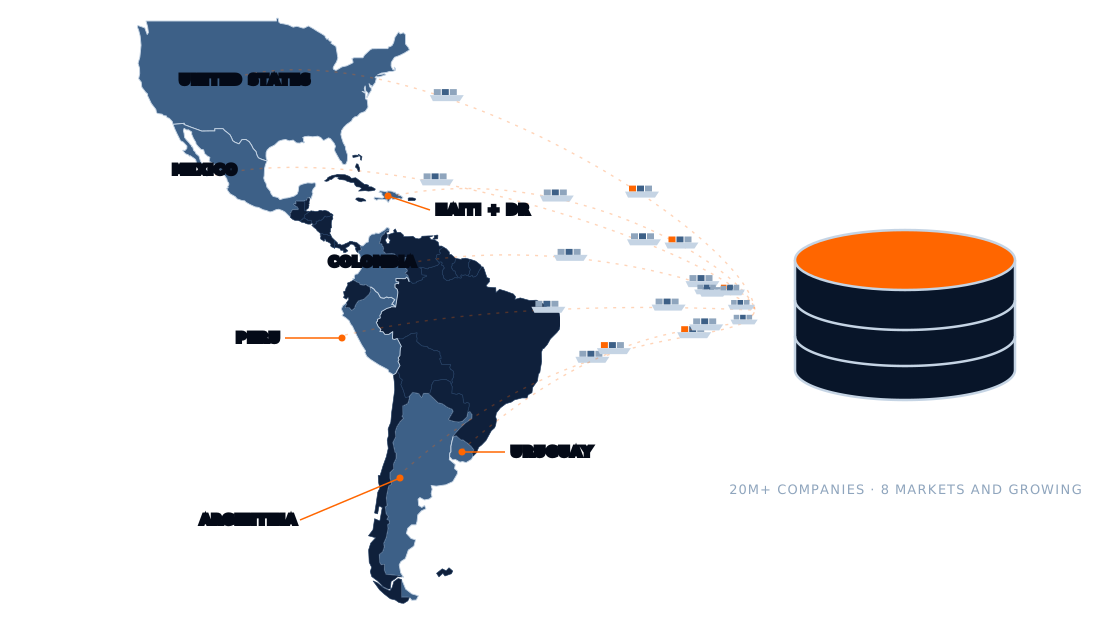
| Market | Region | Flows | History from | Values | Updates |
|---|---|---|---|---|---|
| United States | North America | Imports and exports | Imports January 2022; exports January 2020 | Official values from US Census statistics, by product, partner, and port | Daily |
| Mexico | North America | Imports and exports | January 2023 | Declared customs value | Monthly |
| Haiti | Caribbean | Imports | November 2020 | – | Weekly |
| Dominican Republic | Caribbean | Imports and exports | January 2024 | Declared USD value per line item | Monthly |
| Colombia | Latin America | Imports and exports | January 2001 | Declared customs value | Monthly |
| Peru | Latin America | Imports and exports | January 2026 | Declared customs value | Weekly |
| Argentina | Latin America | Imports | 2017 | Declared FOB value (USD) | Monthly |
| Uruguay | Latin America | Imports and exports | January 2016 | Declared CIF value (USD) | Monthly |
Use cases
Which use cases fit ERP and CRM platforms?
Sales and lead generation
Score and route leads by real import activity.
Sales and lead generationBuyer discovery
Find the companies already importing a product.
Buyer discoverySupplier verification
Add shipment history to supplier and customer records.
Supplier verificationMarket alerts
Send new shipments by followed companies to account owners.
Market alertsIndustries
Which industries do ERP and CRM platforms search?
FAQ
ERPs and CRMs: frequently asked questions
Can CargoFax data be integrated into an existing CRM?
Yes. CargoFax trade data can be integrated into the CRM platforms and workflows a team already uses, and CargoFax customers in Asia already integrate it into their CRM platforms to serve their importer and exporter clients.
How can an ERP or CRM add customs trade data?
Through CargoFax Files, which delivers shipment-level records by FTP, through a web interface, or by API, in CSV, Excel, JSON, or Parquet. Files sends the historical archive first, then new records on each market's update schedule.
How are trade records matched to CRM accounts?
By cleaned company name, and in Mexico, Colombia, Peru, and the Dominican Republic by tax ID (RFC, NIT, RUC, and RNC), which identifies the company on each customs declaration.
Which markets can CargoFax Files deliver?
CargoFax Files delivers the United States, Mexico, Colombia, Peru, the Dominican Republic, Uruguay, and Argentina in bulk, and Haiti bulk files are available on request from sales.
How often are CargoFax Files deliveries updated?
CargoFax Files follows each market's update schedule: US import records daily, Peru weekly, and US exports, Mexico, Colombia, the Dominican Republic, Uruguay, and Argentina monthly.
Can AI agents query CargoFax data?
Yes. The CargoFax MCP server lets AI assistants and agents query CargoFax shipment records. It is in early access for selected clients and prospects: fill out the request form on the CargoFax MCP page and CargoFax will get back to you.
How much does CargoFax cost for ERP and CRM platforms?
CargoFax plans are monthly or annual and priced by markets and data access. Book a demo for a quote.
Get started
Integrate CargoFax trade data into your CRM or ERP today.
Find the suppliers, buyers, and shipping companies you need to grow your business. CargoFax trade data helps you identify real companies, discover new opportunities, and make your next move with confidence.