United States coverage

United States Trade Data

CargoFax provides US import data built from US Customs and Border Protection bill of lading records, updated daily with about a one-day lag. Search every shipment by importer, supplier, HS code, port, or product description in Atlas, with unlimited searches, unlimited downloads, saved queries, and cleaned company names. US import records in CargoFax start in January 2022, US export records, updated monthly, start in January 2020, and official US Census Bureau trade statistics add import and export values.

Every ocean shipment into the United States, searchable the day after it arrives.

Last updated:

United States

Datasets

  • Imports (bills of lading)since January 2022, daily
  • Exports (bills of lading)since January 2020, monthly
  • Census trade statisticssince January 2024, monthly

Top imports by HS chapter

HS 84 Machinery and computersHS 85 Electrical equipmentHS 87 Vehicles and parts
Population, 2026
342.8 million
GDP, 2026 (current US$)
US$32.6 trillion
Average monthly imports, 2026
US$302B
Records in CargoFax
More than 250 million

Snapshot

What does US trade look like in 2026?

US at a glance: the country's size, and what its trade averaged each month this year in the records CargoFax publishes.

Average monthly imports, 2026

Customs value (Census)
US$302B
Weight (bills of lading)
46.1M t
Shipments (bills of lading)
1.70M

Values from US Census Bureau statistics. Weight and shipments from CargoFax ocean bills of lading, with same-month duplicates and implausible weights removed.

Average monthly exports, 2026

Value (f.a.s.) (Census)
US$205B
Weight (bills of lading)
41.1M t
Shipments (bills of lading)
249K

Values from US Census Bureau statistics. Weight and shipments from CargoFax export bills of lading, which include bulk cargo from January 2026, so 2026 figures do not compare with earlier years.

Top imports by HS chapter
Machinery and computers (HS 84)25.3%
Electrical equipment (HS 85)16.7%
Vehicles and parts (HS 87)9.0%
Mineral fuels and oils (HS 27)6.4%
Pharmaceutical products (HS 30)4.5%

2026, share of value. Source: US Census Bureau international trade statistics, general imports (customs value).

Top exports by HS chapter
Mineral fuels and oils (HS 27)16.7%
Machinery and computers (HS 84)13.3%
Electrical equipment (HS 85)10.5%
Precious stones and metals (HS 71)8.1%
Aircraft (HS 88)7.4%

2026, share of value. Source: US Census Bureau international trade statistics, total exports (f.a.s. value).

Population and GDP: IMF World Economic Outlook, October 2026, 2026 estimates. Trade figures: CargoFax monthly report data, averaged over the months of the year published so far.

The data

What does CargoFax US data cover?

CargoFax holds more than 250 million US records, all datasets combined.

US datasets in CargoFax: date range, update frequency, and number of variables
DatasetDate rangeUpdatesVariables
Imports (bills of lading)January 2022 to todayDaily38
Exports (bills of lading)From January 2020Monthly34
Census trade statisticsJanuary 2024 to August 2026Monthly16

For research teams and platforms: US data is also delivered in bulk through Files (FTP or API) and licensed to universities for academic research.

01

Imports (bills of lading)

One record per ocean shipment (bill of lading) from US Customs and Border Protection manifests. Both parties are named on most rows. CargoFax assigns an HS code to every bill of lading from its cargo description.

Key fields

  • Arrival date
  • Master bill of lading
  • House bill of lading
  • Importer (consignee), cleaned
  • Supplier (shipper), cleaned
  • Notify party
  • Cargo description
  • HS code, up to 10 digits
  • HS chapter and heading
  • Gross weight (kg)
  • TEU
  • Container numbers
  • Container count
  • FCL or LCL
  • Country of lading
  • Port of lading
  • US port of unlading
  • Carrier (bill issuer)
  • Shipping line
  • Vessel
  • +17 more variables
02

Exports (bills of lading)

One record per export shipment. The US exporter (shipper) is named, with the destination country, the foreign port of arrival, the carrier, and the vessel. CargoFax derives a six-digit HS code from the cargo description.

Key fields

  • Departure date
  • Bill of lading
  • US exporter (shipper)
  • Shipper address
  • Cargo description
  • HS6 code (CargoFax-assigned)
  • HS6 description
  • Destination country
  • US port of departure
  • Foreign port of arrival
  • Carrier
  • Carrier code (SCAC)
  • Vessel
  • Voyage
  • Weight (kg)
  • Quantity
  • Unit
  • TEU
  • Manufacturer flag
  • +15 more variables
03

Census trade statistics Statistics: no company names

Official US Census Bureau statistics: general imports at customs value and exports at f.a.s. value, one row per month, partner country, US port, and HS6 code, with vessel, air, and containerized values and weights.

Key fields

  • Month
  • Flow
  • Country code
  • Partner country
  • Customs district
  • US port code
  • US port name
  • HS6 code
  • HS description
  • Value (US$)
  • Vessel value
  • Vessel weight
  • Air value
  • Air weight
  • Containerized value
  • Containerized weight

What do you get with CargoFax US import data?

  • Unlimited searches and downloads. No search credits, no per-query limits, no export caps in Atlas.
  • Daily updated records. New bills of lading every day, about one day after release.
  • Cleaned company names. Spelling variants of the same company are grouped so its shipments resolve to one entity.
  • Saved queries and alerts. Save a search, build reports and pivot tables, and get a Vault email update when new matching shipments arrive.
  • Values from Census. CargoFax reports bills of lading in weight and shipments, and US trade values from US Census Bureau statistics.

How does US data reach you?

In Atlas, Explorer searches every US bill of lading, Vault keeps the importers, products, and ports you follow, and Vault emails you when the daily release adds matching shipments.

For teams that load data into their own systems, Files delivers the historical archive (imports from January 2022, exports from January 2020) and daily import and monthly export increments by FTP or API in CSV, Excel, JSON, or Parquet.

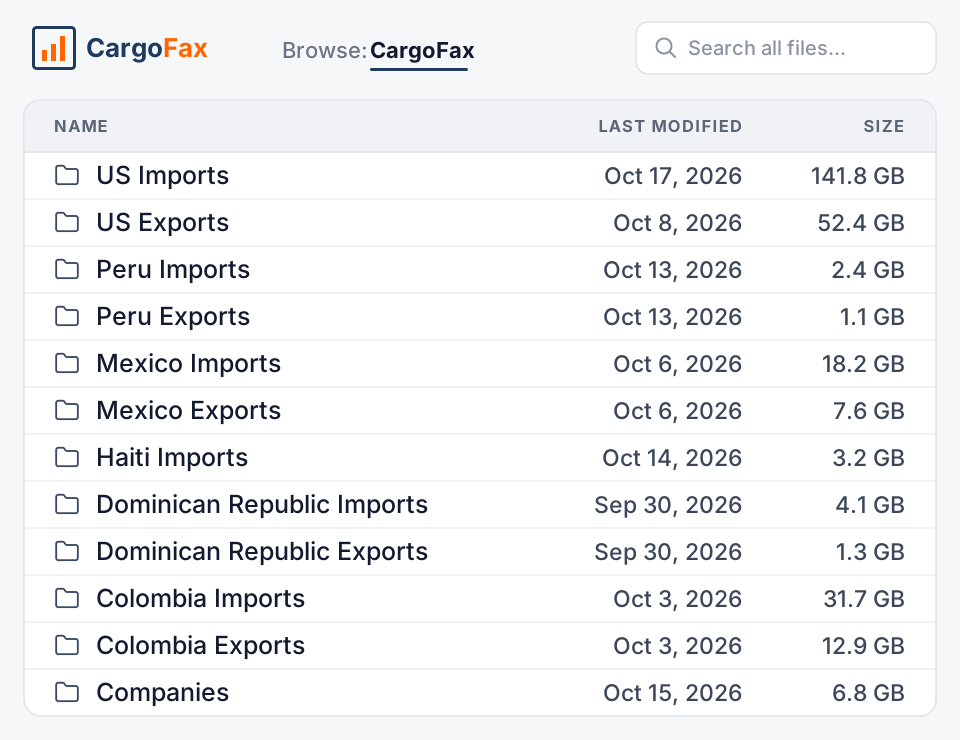
CargoFax Files: folders of bulk datasets by market, with the date each was updated and its size

How does CargoFax compare with Panjiva and ImportGenius?

The comparison uses only what each provider states on its own public website. Where a provider does not publish a fact, the cell says so.

US import data providers compared, from each provider's public website (checked October 2026)
CargoFaxPanjiva (S&P Global)ImportGenius
US bill of lading dataYesYes, waterborne bills of lading Yes, from CBP vessel manifests
US update frequencyDaily, about 1-day lagNot stated publicly Daily
Search limitsUnlimitedNot stated publicly 25 per day (USA Essentials), 50 per day (USA Pro), unlimited (Global Enterprise)
Download limitsUnlimitedNot stated publicly 1,000 to 150,000 rows per month depending on plan; custom on Global Enterprise
Saved searches and alertsYes (Explorer saved queries, Vault email updates)Yes Yes
Haiti customs dataYes, exclusive since 2020Listed on its country coverage page Not listed
Dominican Republic customs dataYes, with declared valuesListed on its country coverage page Not listed

CargoFax also covers Haiti, the Dominican Republic, Mexico, Colombia, Uruguay, Argentina, and Peru in the same platform. See all markets.

Reports and analysis

Where can I follow US trade every month?

Three ways to stay on top of US trade with CargoFax: the numbers, the stories behind them, and an AI analyst that digs into the records for you.

FAQ

US trade data: frequently asked questions

Where can I get US import data?

US import bill of lading records are collected by US Customs and Border Protection. CargoFax publishes them daily in Atlas with unlimited searches and unlimited downloads.

Is US import data public?

US Customs and Border Protection releases vessel manifest information under federal disclosure rules, and importers and shippers can request confidential treatment of their names. The raw records are difficult to use; CargoFax cleans, classifies, and indexes them.

How often is US import data updated?

Daily. New bill of lading records reach Atlas about one day after they are released.

How far back does US import data go?

US import records in CargoFax start in January 2022. US export records start in January 2020, and the US Census statistics in CargoFax start in January 2024.

Can I search US imports by HS code?

Yes, from HS2 chapters to HS10 tariff lines. CargoFax assigns an HS code to every US bill of lading from its cargo description.

Where do US trade values come from?

From official US Census Bureau statistics, by product, partner country, and US port. CargoFax reports US bill of lading data in gross weight and shipments, with the importer, supplier, vessel, containers, and ports of each shipment.

Does US import data show the country of origin?

US bill of lading records show the country and port where the cargo was loaded, and CargoFax uses the country of lading to approximate origin where that distinction matters.

Is CargoFax an alternative to Panjiva or ImportGenius?

Yes. CargoFax covers US bills of lading with daily updates, unlimited searches, and unlimited downloads, and adds Haiti and Dominican Republic customs data. ImportGenius does not list either country on its public website (checked October 2026).

How much does US import data cost?

Atlas plans are monthly or annual and priced by markets and data access. See the pricing page or book a demo for a quote.

Get started

Unlock the Power of United States Trade Data

Book a demo and we'll explore the US records together, to see if they can help your next growth campaign.